


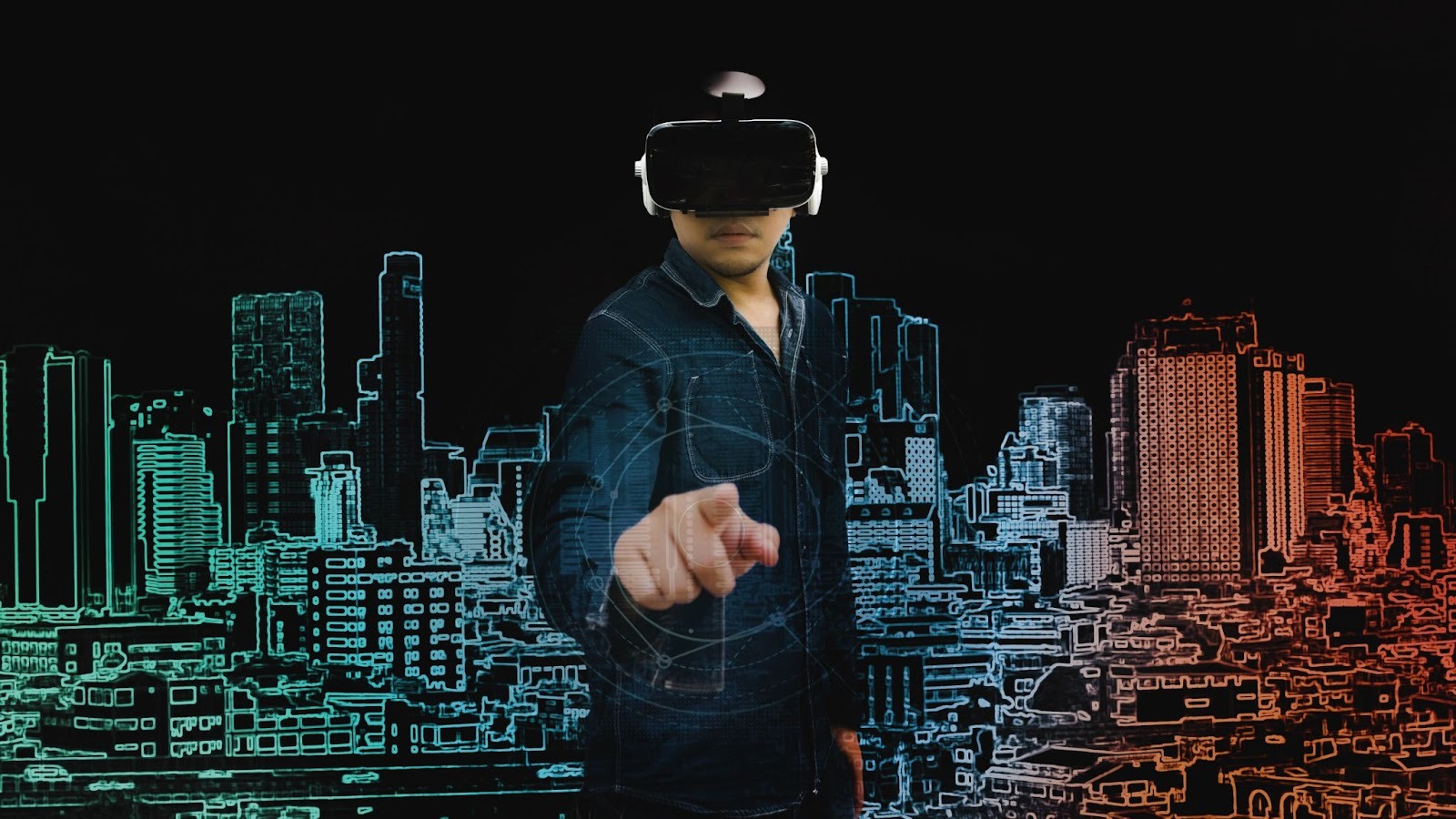
The metaverse is a shared virtual community space, now a centre of technological creativity, drawing the interest of technological giants, investors, and creators alike. The future of the Metaverse is fast changing and is influenced by the development of numerous technologies in virtual reality (VR), augmented reality (AR), blockchain, artificial intelligence (AI), and others, which will shape the world in 2025. In this blog, the author will discuss the recent trends in the Metaverse that are defining its new outlook and compelling us to change the way we communicate with the virtual worlds.
1. The Emerging Threat of Immersive Technologies
VR Virtual Reality and AR Augmented Reality
The immersive technologies are the foundation of the Metaverse. The recent development in VR and AR is preconditioning more interactive and deep experiences.
Next-Generation VR Headsets: Meta, Sony and HTC corporations have also launched VR headsets with higher resolutions, broader fields of view and comfort. An example of this is the Meta Quest Pro, which combines the features of advanced eye-tracking and hand-tracking, which enables users to engage with their virtual spaces in a more instinctive manner.
AR Glasses: The Apple Vision Pro and Microsoft HoloLens are the first steps toward AR applications that will overlay digital content on the real world. They are glasses that allow the user to superimpose information on the environment to make the work and play experiences better. AR as a tool in education, the retail industry, and remote work has hugely major potential, leading to the opportunity to learn and work interactively and more productively.
Mixed Reality Experiences
Mixed reality (MR) is becoming a trend because it is an integration of VR and AR, which forms hybrid experiences. Spatial and Engage are among the platforms using MR to conduct a virtual meeting and workspaces, and thus, make remote communication look more like a face-to-face meeting.
2. Metaverse and Blockchain Decentralization
The part played by Blockchain Technology
Blockchain is transforming the ownership and trading of digital assets in the meta-verse. The technology offers a safe and transparent system of carrying out the transactions which means that the users can purchase, sell, and trade virtual goods and services without any doubt.
NFTs and Digital Assets: Non-fungible tokens (NFTs) have already conquered the Metaverse, enabling users to be the owners of one-of-a-kind digital objects, including virtual real estate or rare collectibles. Social networks such as Decentraland and The Sandbox are pioneering the development of a decentralized market, in which users are able to sell their NFTs and virtual properties.
Decentralized Finance (DeFi): It is also establishing new sources of economics with the integration of DeFi into the Metaverse. Users can invest their digital assets to earn interest, trade in cryptocurrencies, and engage in governance via decentralized self-sovereign entities (DAOs). This move is both empowering creators and users, and allows them to directly monetize their work and contributions.
3. Artificial Intelligence Reshaping the User Interactions
The role of AI in the Metaverse is to improve user experiences. Smart avatars to smart content generation, AI technologies are transforming the virtual world into an interactive and personal space.
Intelligent NPCs and Virtual Friends
Among the most thrilling trends, the invention of AI-based non-player characters (NPCs) that learn and interact with users is a thrilling one. These intelligent NPCs have the capability of giving help, getting involved in dialogues, and even a kind of companion-ship, which makes virtual worlds more the living world. As an example, AI may allow NPCs in game to react to player actions in real-time, which can be seen as a more immersive storytelling experience.
Personalization and Content Creation
It is also through AI that content creation in the Metaverse is simplified. Machine learning-powered tools can also assist developers to create 3D utility, animation, and environments more effectively. Users who may lack a lot of technical expertise in creating content can thus become part of the Metaverse and it encourages a wide variety of creators.
4. Connection and Infrastructural Development
5G and Edge Computing
The implementation of 5G networks is a breakthrough to the Metaverse. The 5G is capable of high-speed, low-latency, which makes it possible to stream high-quality VR and AR content. This enhanced connectivity can enable a bigger number of users to communicate in real time within common virtual worlds to increase social experiences and collaborative potential.
Another technology that is becoming significant is edge computing which is a processing of data nearer to the source thus minimizing latency and enhancing responsiveness of applications. The technology will be especially relevant in real-time communication in gaming, virtual meetings, and other collaborative experiences in the Metaverse.
Improved Cloud Services
Cloud computing is offering the infrastructure which is needed to sustain the huge volumes of data that are being created within the Metaverse. Scalable solutions such as AWS, Google Cloud and Microsoft Azure are providing the development capability to develop and host immersive applications with low latency and high reliability. These innovations allow users to have high quality experiences without having to have robust local hardware.
5. The Changing Social Interaction
Virtual Social Spaces
With the growth of the Metaverse, virtual social spaces are now indispensable to users in order to socialize and interact. Applications such as Horizon Worlds and VRChat are constantly being developed to improve social living, enabling individuals to attend events, parties, and collaborative projects in the world of immersion.
Hybrid Events
The COVID-19 pandemic has enhanced the use of hybrid events, a combination of real and virtual experiences. Companies are currently organizing conferences, concerts, and social events in the Metaverse, which enable wider and more active participation and engagement of a global audience. These hybrid events provide one with special networking and collaboration possibilities which overcome geographical boundaries.
6. Ethical Standards and Regulatory Innovations
Data Privacy and Security
Due to the expansion of the Metaverse, issues of data security and privacy are increasing. Users must have the assurance of their safety on virtual platforms, which websites and software developers should introduce effective privacy policies and data protection measures. Firms are also placing user consent and transparency as an important priority to develop trust in their services.
Electronic Identity Checking
The need to have safe identity authentication in the Metaverse is gaining importance. The technology is being created to ensure that users have secure and verifiable identities through such technologies as biometric authentication and identity solutions based on blockchains. This is essential security to secure interactions and transactions in the Metaverse.
7. Interoperability among Platforms
Cross-Platform Experiences
The inclination towards platform interoperability is one of the biggest trends in the Metaverse. There is an attempt to develop standards that will enable users to transfer their avatars, digital assets, and experiences between the various virtual environments. Such interoperability will improve the interaction with the users and create a more coherent experience of the Metaverse.
Conclusion
Metaverse is at the edge of a technological revolution brought by the innovation of VR, AR, blockchain, AI, and connectivity. Through these developments, we are entering into the year 2025 with the ability to interact with digital content and with one another creating a more user-centric and interconnected virtual world that is more immersive.
The knowledge of such trends will become fundamental to individuals, businesses, and creators who want to operate in the Metaverse successfully. With the ever-changing aspects of technology, the innovation and creativity within the Metaverse is open to endless possibilities and prospects in the future.